
This summer, on August 8th and 9th, Loveland Festival 2026 returns to Sloterpark in Amsterdam. If you’ve never danced beside a Dutch lake while the sun melts into the horizon and you hear the beats reverberating through the trees, you’re missing one of Europe’s most looked forward to festival experiences.
Everyone knows that Amsterdam has no shortage of electronic music. The city actually breathes it. From ADE’s club marathons to warehouse raves tucked into industrial corners, dance culture here is built into the city’s infrastructure. There’s a certain rhythm to this city too; bicycles gliding past canals, conversations unfolding slowly at terrace cafés, music drifting from open windows.
Loveland holds a different position within that ecosystem though. It has never tried to be the loudest. It definitely doesn’t rely on spectacle alone. Instead, it has refined its identity year after year. It’s a festival where you don’t have to rush between stages basis the line-up, rather, you take a walk, you wander, you explore artists.
Artists of Loveland Festival 2026
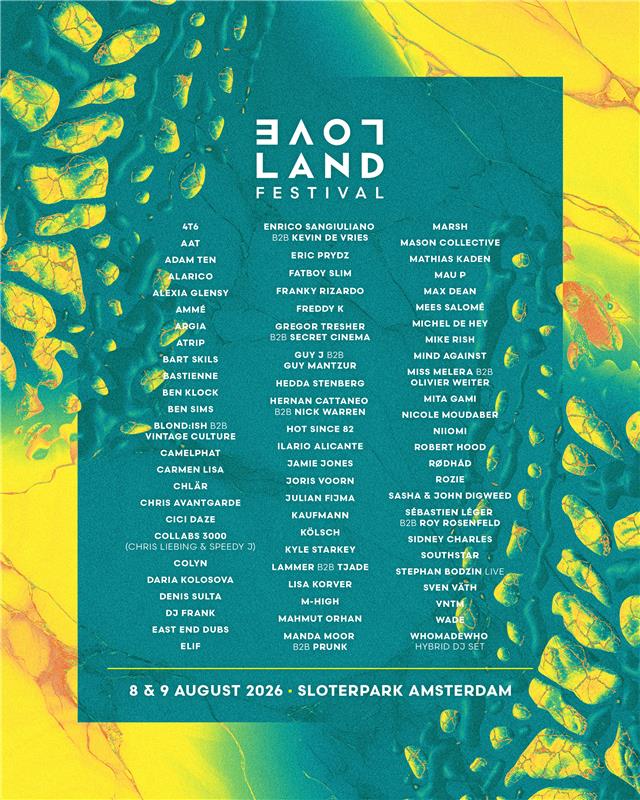
If Loveland’s past editions are anything to go by, the 2026 line-up feels like a continuation of a story that’s been unfolding for decades. Several artists like Vintage Culture, Camelphat, Guy J, Guy Mantzur, Sasha and John Digweed, Hedda Stenberg, Hernan Cattaneo and Nick Warren, Jamie Jones, Joris Voorn, Sébastian Léger, Roy Rosenfeld and Sven Väth return to Sloterpark.
Check out full line-up here:
The Setting: Sloterpark and the Sound of Six Stages
Loveland Festival takes place at Sloterpark, Amsterdam. With more than 300 acres, Sloterpark is Amsterdam’s largest park. Located in Amsterdam’s western neighborhoods (Nieuw-West), it was developed in the 1950s across the lake Sloterplas. And let me tell you, there’s something absolutely surreal about hearing rolling beats in this environment.
The open water absorbs the bass, the trees soften the high frequencies, and as the sun begins to dip, the entire park feels like it’s breathing in sync with the kick drum.
Loveland’s layout is anchored by six carefully curated stages, each with its own sonic identity.
Fire is the powerhouse. This is where peak-time European techno takes control. Bold, driving, authoritative. Expect high-impact sets, commanding drops, and the kind of production that turns dusk into a cinematic moment. Arena shifts the energy toward groove. Rolling tech-house, global house sounds, and dance floor-focused rhythms dominate here. 909 is Loveland’s purist corner. Named after the iconic Roland TR-909, this stage is rooted in raw, stripped-back techno. Industrial edges, hypnotic repetition, and uncompromising underground credibility define the atmosphere.
Rise leans into melody. Emotional builds, soaring synth lines, and progressive storytelling make this stage particularly powerful as sunset approaches. It’s expansive without being overwhelming. Next thrives on unpredictability. Expect eclectic selections, from afro-infused house to punchy modern club sounds. It’s intimate, slightly left of center, and often where discovery happens. Circle is perhaps the most immersive of all. Dedicated to progressive journeys and extended storytelling sets, this stage feels timeless. The music unfolds patiently, rewarding listeners who stay for the long arc rather than the quick hit.
From “Swim & Dance” to Sloterpark Must-Go
Loveland’s roots stretch back to August 12, 1995. Founder Marnix Bal launched the first edition under the name “Swim & Dance” at a tropical swimming pool in Zandvoort. At a time when house music faced skepticism, the event was cleverly framed as a charity initiative promoting safe sex under the Loveland Foundation.
What began as a strategic workaround became a defining chapter in Dutch electronic culture. Over three decades, Loveland evolved alongside the scene it helped shape. It outlasted trends. It adapted without losing its identity. And in doing so, it became one of Amsterdam’s most consistent electronic institutions.
Sustainability as a Core Principle
Since 2004, sustainable production has been a priority. In 2018, Loveland became FutureProofFestival certified. The organisation also joined the Plastic Promise movement, working to significantly reduce single-use plastics across its events. In 2024 alone, more than 500,000 cups were recycled through its PET deposit system. Waste per visitor has dropped dramatically over the years, with clear targets in place for residual waste and recycling percentages.
Energy management continues to evolve as well. Increasing reliance on grid electricity, battery systems during production phases, and HVO-powered generators reflect a long-term commitment to reducing environmental impact. Even mobility reflects this mindset. Over 90% of visitors now arrive by bicycle or sustainable transport, a statistic that feels uniquely Amsterdam.
The Loveland Ecosystem
Loveland Festival may be the flagship event, but Loveland Events operates year-round. Loveland Burst on Kingsday, April 27 transforms Meerpark into a vibrant electronic celebration aligned with the city’s iconic orange festivities. 909 Festival, held in June at Amsterdamse Bos, is a techno purist’s gathering dedicated to the legendary TR-909 drum machine sound, raw, stripped-back, and deeply rooted. During October’s Amsterdam Dance Event (ADE), Loveland hosts a series of curated club nights, bringing its outdoor ethos into more intimate spaces.
Tickets, Access & Planning Your Visit
Tickets are available through the official website and as with most Amsterdam summer events, early booking is highly recommended. For those planning to fully immerse themselves in the weekend, the Weekend Regular Release ticket is priced at €136.00 + €3.95 service fee. It’s the most popular option, giving access to both Saturday and Sunday. For a more elevated experience, the Weekend Backstage Pass is available at €350.00 + €3.95 service fee, offering exclusive access areas and a different perspective on the festival’s production and artist zones.
If you prefer a single-day visit, individual day tickets for Saturday and Sunday are also available. Beyond entry, the website also allows visitors to pre-book practical essentials. Lockers can be reserved in advance, a smart move if you’re traveling internationally. Shuttle bus return tickets are also available for purchase online, making transport hassle free.
Getting to Loveland remains simple. The nearest train station is Amsterdam Sloterdijk, where festival shuttle buses run consistently throughout the day. For those embracing Amsterdam’s cycling culture, bike travel is strongly encouraged, with extensive parking available onsite. Taxi drop-off points and a designated Park & Shuttle service from Heining 43 ensure additional flexibility for visitors staying outside the immediate city center.
Loveland Festival 2026 is strictly 18+, and valid identification is required for entry, a small but important detail for international guests planning ahead.
Stay updated with Loveland festival 2026 via their instagram handle.